Australia
United States
International



Perth non-qualification carries consequences beyond a missed main event.
The absence of an SX2 last-chance qualifier left Lux Turner as a primary talking point following Perth’s penultimate round of AUSX, with consequences for his title campaign raising wider questions over main event qualifying procedures – here’s why.
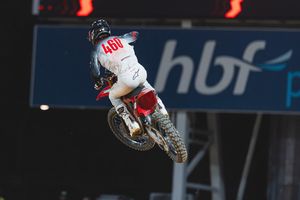
Fastest in qualifying and leading his heat at HBF Park before an untimely bike issue struck, the Monster Energy Yamalube Yamaha rider’s night ultimately ended without scoring a single point.
“Plain and simple, I had a DNF in my heat race and there’s no LCQ,” Turner told MotoOnline in an exclusive post-event interview that’s since been removed, albeit circulated online elsewhere. “And they pretty much just told me, ‘Go home.’ I mean, that’s it.”
For Turner, the disappointment extended beyond being unable to convert his speed into a result. The highly-rated 21-year-old American – who firmly put himself on the global radar in AUSX one year ago – saw his championship aspirations take a significant hit, while the financial implications were also front of mind.
“My team works so hard, I work so hard,” he continued. “Even if I didn’t even win the championship, I still would have made another 50 grand for second in the championship.”

Image: Foremost Media.
It highlighted what these international riders stand to gain – and lose – by committing their Monster Energy SMX World Championship off-season to Australia. After entering 2026 as a clear title candidate after being injured while comfortably leading SX2 last year, Turner now sits fifth in the SX2 standings, 36 points behind red plate-holder Cameron McAdoo (Honda Racing) with only Newcastle’s two finals remaining.
So what actually happened last Saturday night? Organisers have defined that 26 entries are required for an LCQ. In that case, seven then advance from each heat, leaving 12 to fight for the four remaining positions in the 18-gate main event. Below that threshold, however, nine riders instead transfer directly from each heat and that’s it.
Without the required amount of SX2 entries, Perth’s schedule contained no LCQ, meaning it wasn’t actually removed after Turner’s casualty – it was planned and evident in advance. Teams had an opportunity to identify that beforehand, even if final instructions referencing both nine direct transfers and four SX2 LCQ qualifiers hardly provided clarity.
Geelong’s AUSX OPEN provides another point worth clarifying. Official timing recorded 23 riders in combined SX1 qualifying, yet an eight-rider LCQ went ahead. While entries and starters can often offer different metrics, the circumstances that permitted an LCQ at Geelong, but prevented one at Perth deserve attention.

Image: Foremost Media.
Turner did acknowledge that mechanical failures happen and the timing of this one couldn’t have been worse. His YZ250F needed to finish the heat, plus even then, another race would not have guaranteed qualification or a main event finish, but that’s largely beside the point.
What an LCQ provides is an opportunity to recover from that kind of misfortune. That opportunity should apply equally to a title contender, an international guest or a privateer competitor. It guarantees nobody a main-event start, but it does provide a second qualifying avenue when something inevitably goes wrong.
That matter is amplified further across a series stretching from Townsville to Auckland, Geelong, Perth and Newcastle in the span of two months. Riders and teams are investing heavily, and the sporting framework must justify that commitment for the broad competitor group.
“Really bummed for Lux Turner [and] his team that a mechanical issue took him out last night,” AUSX CEO Adam Bailey stated publicly on social media platform, X. “To clarify, the schedule went out Monday without an LCQ (due to not enough riders). Not one comment or complaint. The schedule wasn’t ‘changed’ to remove the LCQ. It were never there.”

Image: Foremost Media.
Alongside the well-documented Triple Crown/traditional format reversal in the lead-up to Western Australia and serious flagging concerns during the night program, Perth underlined the need to once again get the fundamentals right long before bikes reach the dirt-covered stadium floors of AUSX.
All of these instances require review and clarification, both from AME Group and those in race direction. Riders must understand and be able to trust the flags being deployed, particularly when they communicate race distance or hazards ahead. By now, the accumulated drama that’s unfolding has become a distraction from the racing itself.
AMA Supercross in the United States has long provided an established reference at the highest of levels. Australia operates at a different scale, but clear qualifying pathways, standardised procedures and reliable signals require the same amount of attention and an equally important degree of consistency. There is minimal margin for error.
Turner’s reaction was raw and the impact on his season was real. Resolving the situation for an improved outcome into the future must now be a priority for those in control, and how AUSX responds from here – at least come the 2027 series – will matter far more than any criticism being directed at the group in the meantime.